
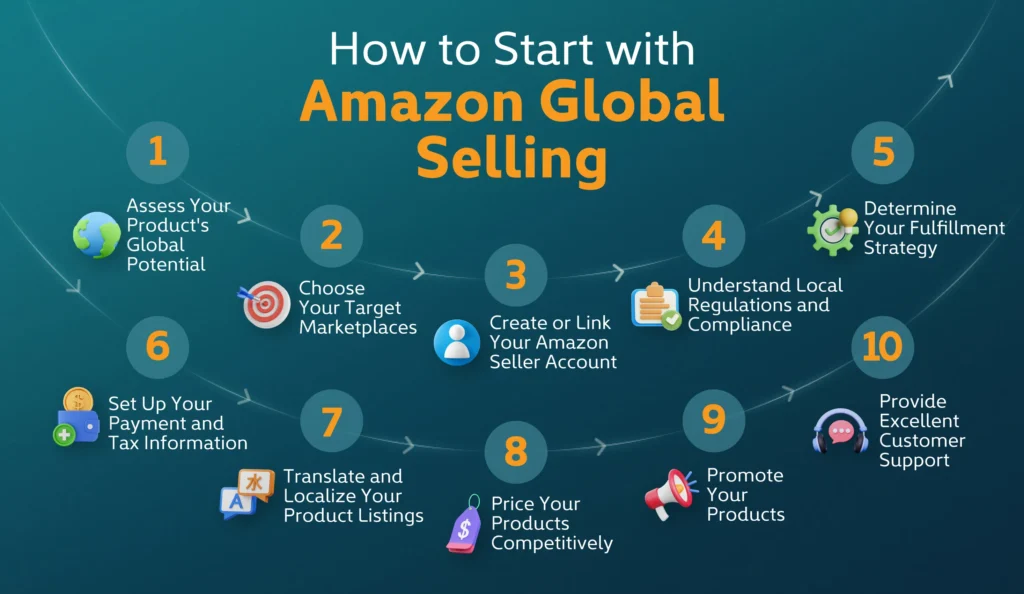
Many Indian sellers succeed on Amazon India—but real scale begins when you go global. With access to marketplaces like the USA, UK, and UAE, Amazon enables brands to multiply revenue without building new infrastructure overseas.
However, Amazon global selling is not as simple as copying listings from India to international marketplaces. Sellers who scale successfully do so with localized strategy, compliance awareness, and marketplace-specific execution.
This guide explains:
- How to sell on Amazon USA, UK, and UAE
- What changes when you move from India to global markets
- How to scale international sales sustainably
What Is Amazon Global Selling?
Amazon Global Selling is Amazon’s program that allows sellers to list and sell products across international marketplaces from a single Seller Central account (or linked accounts).
Through global selling, Indian brands can access:
- Amazon USA (.com) – world’s largest ecommerce market
- Amazon UK (.co.uk) – strong brand and repeat purchase market
- Amazon UAE (.ae) – high purchasing power, lower competition
For many sellers, global selling becomes the fastest path to scale once domestic growth plateaus.
Why Indian Sellers Should Expand Internationally
1. Larger Market Size & Higher AOV
Markets like the USA and UK offer:
- Higher average order values
- Strong buying intent
- Willingness to pay for branded products
The same product often sells at 2–3× Indian price points internationally.
2. Reduced Price Sensitivity
Compared to Amazon India, international buyers are:
- Less price-sensitive
- More brand-focused
- More review-driven
This improves profit margins when executed correctly.
3. Diversified Revenue Streams
Relying on one marketplace is risky.
Selling on:
- Amazon India
- Amazon USA
- Amazon UK
- Amazon UAE
Creates geographic revenue diversification, protecting your business from regional slowdowns or policy changes.
How Selling Internationally Is Different from Amazon India
Many sellers fail globally because they assume Amazon works the same everywhere. It doesn’t.
Key Differences You Must Account For
1. Marketplace-Specific SEO (A9/A10 Behavior)
- Keywords differ by country
- Search intent varies
- Competition levels change drastically
A keyword that performs in India may be irrelevant in the USA or UK.
2. Compliance & Documentation
International selling involves:
- Product safety standards
- Labeling and packaging rules
- Restricted category compliance
- Import/export documentation
Non-compliance can lead to instant listing suppression or account suspension.
3. Fulfillment & Logistics Strategy
You must choose between:
- FBA international fulfillment
- Export-based fulfillment (EFN)
- Local warehousing
Each market requires a cost vs speed trade-off.
How to Sell on Amazon USA, UK & UAE (Strategic Approach)
Step 1: Market & Product Validation
Before listing, successful sellers analyze:
- Demand vs competition
- Pricing viability
- Shipping and duty impact
- Review benchmarks
Not every Indian bestseller works globally.
Step 2: Localized Listing Optimization
Each marketplace needs:
- Country-specific keyword research
- Localized spelling and terminology
- Region-compliant images and claims
- Optimized pricing strategy
This is Amazon SEO adapted to local buyer psychology.
Step 3: International PPC Strategy
Amazon PPC behaves differently across regions:
- CPCs vary significantly
- Competition intensity changes
- Conversion rates differ
Professional Amazon PPC management is essential during international launches to control spend and gather data.
Step 4: Account Health & Compliance Monitoring
Global accounts face higher scrutiny.
You must monitor:
- Policy compliance per marketplace
- Account health metrics
- Performance notifications
- Listing suppressions
International suspensions are harder and slower to recover without expert handling.
Common Mistakes in Amazon Global Selling
❌ Copy-pasting Indian listings globally
❌ Ignoring VAT/GST and tax setup
❌ Underestimating logistics costs
❌ Running ads without SEO foundation
❌ No international account health monitoring
These mistakes often lead to low sales or costly failures.
How Professional Sellers Scale Internationally (The Right Way)
Top global sellers follow a managed expansion model:
- Market-by-market rollout
- SEO + PPC launch strategy
- Controlled inventory deployment
- Continuous performance optimization
- Centralized account health management
This approach minimizes risk and maximizes long-term returns.
When Should You Consider Amazon Global Selling?
You’re ready for international expansion if:
- Your India sales are stable
- You have consistent reviews and conversion
- You can manage inventory planning
- You want to scale beyond local limits
Global selling is not a shortcut—but it is a force multiplier when done right.
Final Thoughts: Global Scale Requires Local Strategy
Selling on Amazon USA, UK, and UAE opens massive growth opportunities—but only for sellers who treat each marketplace as a separate business, not just another tab in Seller Central.
With the right strategy, Amazon global selling can turn a domestic brand into an international one.